✓ Table of Contents
Cybercriminals continue to exploit stolen data and trusted brands to launch phishing attacks, account takeovers, and fraud campaigns. Recently, an alleged database linked to reservations.mexitravels.com surfaced on Pwnforums.st, raising concerns among security professionals and organizations. A reliable URL scanner can help security teams identify suspicious domains and reduce risks before attackers weaponize compromised information. 🚨
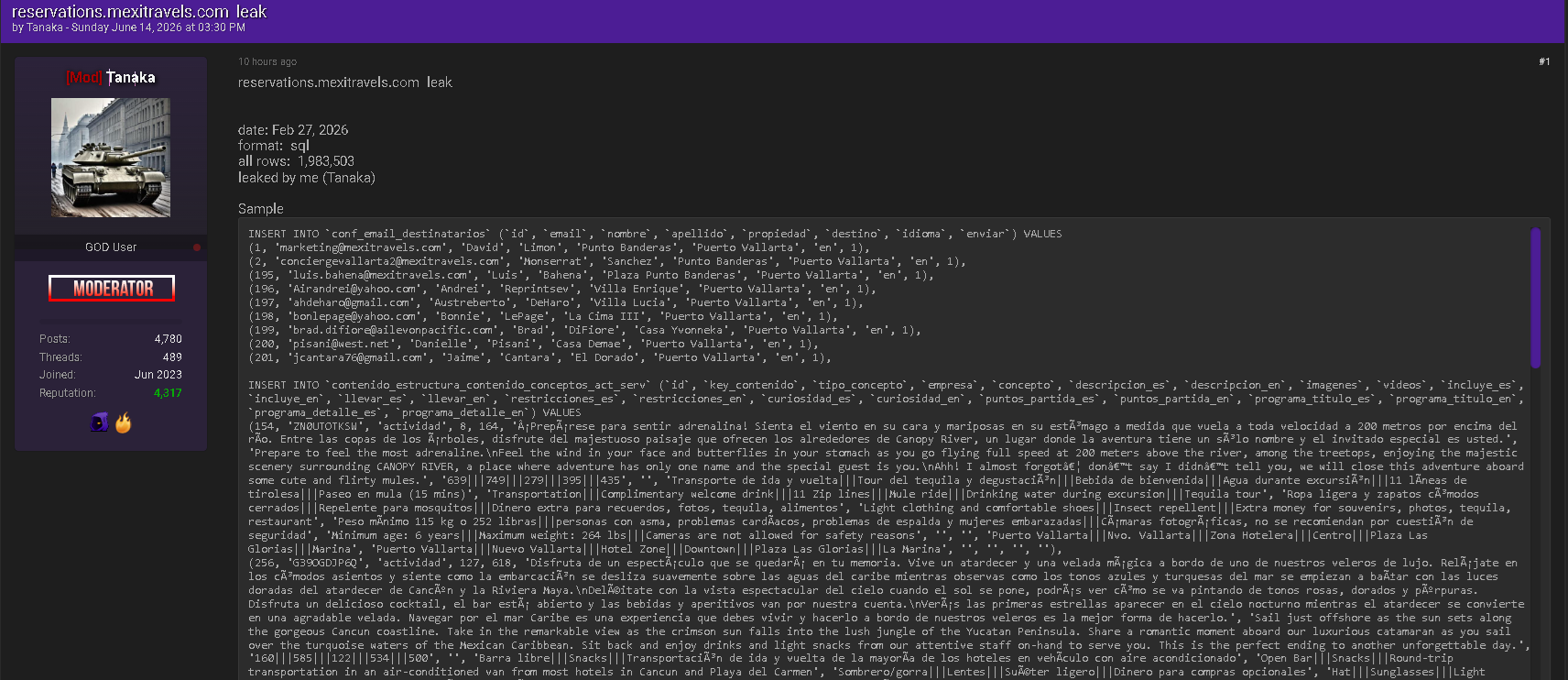
According to the forum post published by the threat actor known as “Tanaka,” the alleged breach dates back to 16 February 2026. The exposed content reportedly contains SQL database entries involving email recipients and content structure records.
Although the claims remain unverified, incidents like this demonstrate why proactive malicious domain detection and continuous monitoring are critical for businesses. 🔍
What Is the Alleged reservations.mexitravels.com Leak?
The alleged leak was advertised on Pwnforums.st by an actor named Tanaka.
Alleged breached date: 16 February 2026
The exposed information reportedly includes SQL records such as:
- Email addresses.
- First names and surnames.
- Property information.
- Destination data.
- Language preferences.
- Travel-related content records.
- Descriptions and multimedia references.
At the time of writing, independent verification of the claims has not been publicly confirmed. Nevertheless, organizations should treat such disclosures seriously because threat actors frequently use leaked information for phishing and impersonation attacks. ⚠️
Why This Incident Matters
Travel-related platforms often process sensitive customer information.
Potential risks include:
| Risk | Possible Impact |
| Credential abuse | Account takeover |
| Phishing campaigns | Financial losses |
| Brand impersonation | Reputation damage |
| Data theft | Privacy concerns |
| Fraud attempts | Customer trust erosion |
Attackers can leverage exposed contact information to launch sophisticated phishing campaigns and create fake domains designed to mimic legitimate travel websites. 🌎
How Attackers Use Leaked Information
Threat actors rarely stop at selling databases.
A common attack chain involves:
- Publishing stolen records.
- Building phishing pages.
- Sending fraudulent emails.
- Harvesting credentials.
- Conducting account takeover attacks.
- Monetizing access through cybercrime forums. 💀
These campaigns often rely on AI phishing detection evasion techniques and deceptive domains.
Security teams increasingly deploy malicious domain detection capabilities to uncover fraudulent infrastructure before users become victims.
The Growing Importance of Domain Intelligence
Modern cybercriminals exploit trusted brands because users are more likely to interact with familiar websites. 🛡️
Organizations should monitor:
- Typosquatting domains.
- Newly registered domains.
- Phishing websites.
- Fake login portals.
- Brand impersonation campaigns.
- Suspicious DNS activity.
Understanding how to monitor domains for brand abuse has become a key component of enterprise security strategies.
Continuous monitoring helps security teams respond before malicious campaigns spread.
URL Scanner Technologies Help Reduce Exposure
A modern URL scanner provides visibility into suspicious infrastructure and phishing campaigns.
Key capabilities include:
- Reputation analysis.
- Threat intelligence feeds.
- Domain age inspection.
- SSL certificate evaluation.
- Behavioral analysis.
- Risk scoring.
Combined with AI phishing detection, these technologies enable organizations to identify emerging threats faster. 🚀
Many security teams also integrate machine learning models to improve malicious domain detection and uncover hidden phishing campaigns.
How to Detect Phishing Websites
Many users ask:
How to detect phishing websites?
The answer is straightforward.
Security teams should examine:
- Domain reputation.
- WHOIS information.
- SSL certificates.
- Redirect chains.
- Hosting infrastructure.
- Suspicious content patterns.
Using a real time phishing URL scanner provides additional protection by analyzing links before users interact with them.
Proactive detection significantly reduces exposure to credential theft and fraud. 🔐
Practical Checklist for Security Teams
✅ Review suspicious domains regularly.
✅ Enable email security controls.
✅ Implement DNS filtering.
✅ Deploy AI phishing detection solutions.
✅ Strengthen malicious domain detection processes.
✅ Monitor newly registered domains.
✅ Investigate phishing reports promptly.
✅ Conduct employee awareness training.
✅ Evaluate suspicious links with a URL scanner.
✅ Incorporate threat intelligence feeds. 📋
Could Leaked Data Fuel Future Attacks?
Yes.
Even unverified breaches may become valuable assets for cybercriminals.
Exposed contact information can enable:
- Spear-phishing attacks.
- Credential stuffing.
- Social engineering campaigns.
- Business email compromise.
- Brand impersonation.
Threat actors frequently combine leaked information with malicious domains to maximize success rates. 😨
Organizations that fail to monitor these threats may discover attacks only after customers report suspicious activity.
Why AI Phishing Detection Is Becoming Essential
Traditional blacklists alone are no longer sufficient.
Attackers constantly register new domains and rotate infrastructure.
Modern AI phishing detection solutions can:
- Analyze domain behavior.
- Identify suspicious patterns.
- Detect newly created phishing sites.
- Improve incident response speed.
These capabilities complement existing malicious domain detection systems and provide stronger protection against emerging threats.
The Role of External Intelligence
External intelligence helps organizations understand attacker activity beyond their perimeter.
Useful sources include:
- Threat intelligence platforms.
- Domain reputation databases.
- DNS monitoring services.
- Security researchers.
- Industry advisories.
Organizations can also benefit from a Dark web scanner to identify leaked credentials and references to corporate assets. 🔎
According to the Anti-Phishing Working Group (APWG), phishing attacks continue to evolve and remain one of the most persistent threats facing businesses worldwide.
External reference:
How URLScore.ai Supports Threat Detection
URLScore.ai helps organizations improve visibility into suspicious infrastructure and phishing risks.
Capabilities include:
- Advanced URL scanner
- Automated malicious domain detection.
- Machine learning-driven threat assessment.
- Enhanced AI phishing detection.
- Risk scoring and domain intelligence. 📈
Conclusion
The alleged reservations.mexitravels.com leak highlights the growing importance of domain intelligence and proactive threat monitoring. While the claims remain unverified, exposed information can provide cybercriminals with valuable material for phishing attacks and impersonation campaigns.
A robust URL scanner, combined with malicious domain detection and AI phishing detection, enables organizations to identify suspicious infrastructure before attacks escalate.
Businesses that prioritize visibility and continuous monitoring are better positioned to reduce risk and protect customers. 🔥
Discover much more in our complete guide
Request a demo NOW
Disclaimer: urlscore.ai reports on publicly available threat-intelligence sources. Inclusion of an organization in an article does not imply confirmed compromise. All claims are attributed to external sources unless explicitly verified.